
Sabrina Carpenter Was Once Called a “Slut.” Now That She Owns Her Sexuality, People Still Have a Problem.
Why society still can't handle a woman who takes control of her image.

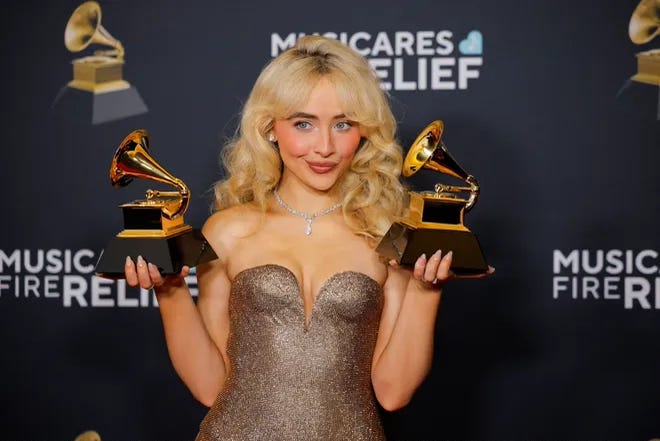
In 2021, the internet came for Sabrina Carpenter. Hard. Tangled up in a tabloid-friendly triangle with Olivia Rodrigo and Joshua Bassett a situation none of the three parties ever fully confirmed. Carpenter quickly became the scapegoat. While Rodrigo’s drivers license soared to No. 1 and Bassett got a temporary pass, Carpenter was branded with a title as old as pop stardom itself: “slut.”
She was slut-shamed not for anything concrete, but for existing at the intersection of youth, beauty, and rumor. “Skin,” her response single at the time, was met with backlash—not because it was offensive, but because it was confident. That confidence, apparently, made people uncomfortable.
Fast forward to 2024. Carpenter has flipped the script with a wink. Her chart-topping singles “Espresso” and “Please Please Please” have transformed her into one of pop’s most compelling new voices. She’s toured with Taylor Swift, commanding stadium stages with choreographed confidence and old-Hollywood glamor. And now, she’s facing a fresh round of criticism; this time for being too confident, too sexy, too self-aware.
So what gives? Why is a woman who was once shamed for a sexuality imposed on her now being shamed for embracing it?
The Slut-to-Star Pipeline
It’s a well-worn path in pop music. A young female artist is sexualized by fans, media, and industry executives alike; then punished when she attempts to reclaim the image they projected onto her. Britney Spears. Christina Aguilera. Miley Cyrus. Even Madonna. All were deemed “too provocative” the moment they started curating their own sexual agency.
Carpenter is the latest addition to that lineage. But unlike some of her predecessors, her reclamation hasn’t been an explosive rebrand. It’s been a slow, confident simmer. emails i can’t send hinted at it in 2022, but it’s “Espresso” that really put her in control: a pop earworm with the self-assured hook, “That’s that me espresso / I’m working late, ‘cause I’m a singer.”
In the video, she plays the role of a cheeky, hyper-feminine bombshell. An aesthetic she’s leaned into with vintage curls, mini dresses, and a wink that says she knows exactly what she’s doing.
But that wink, for some, is the problem.
Pop Feminism Has Limits
On paper, Carpenter’s success should be a feminist win. She took control of a narrative built against her and turned it into a global tour, platinum singles, and widespread acclaim. But the backlash she’s now receiving—accusations of being “too much,” of “trying too hard,” of “manufactured sex appeal”—reveals a deeper cultural hypocrisy.
We claim to celebrate female empowerment. We post graphics about autonomy, consent, and liberation. But the second a woman starts to live that out loud on her terms, and in public we flinch. The moment confidence becomes sexual, and sexual becomes visible, we retreat back into coded puritanism.
It’s the difference between “girl power” and actual power. The former looks good on a T-shirt. The latter makes people uncomfortable.
Agency Isn’t a Costume
Carpenter isn’t reinventing the wheel—she’s just driving it with more clarity than most of her peers. There’s an intentionality to her current era that makes people uneasy. “Please Please Please” pairs a lovesick plea with a cinematic bad-boy aesthetic; she knows it’s camp, and she leans in.
The artistry isn’t just in the visuals or lyrics; it’s in the control. Carpenter isn’t being marketed as sexy. She’s choosing to be. And for many, that autonomy feels threatening.
It's a stark contrast to 2021, when the same public that now accuses her of performativity had no issue labeling her with a misogynistic slur based on little more than vibes and viral theories. There’s a throughline here: people are far more comfortable punishing women than celebrating them.
Especially when they take the narrative back.
Let Women Be Loud
It’s easy to roll your eyes at pop’s fixation with aesthetics, but Sabrina Carpenter’s current era isn’t just about glam and glitter. It’s about control. It's about what it means for a woman to be both the object and author of her story.
When Carpenter sings about how good she looks, how in love she is, or how late she’s been working, she’s not begging for permission. She’s building a persona like every male rock star and rapper before her only she’s doing it in a world that still wants her to apologize for existing.
So if you liked making jokes at her expense in 2021, but are now uncomfortable watching her succeed in full color, maybe the problem isn’t her image. Maybe the problem is how little space our culture gives women to grow, to evolve, and to enjoy themselves along the way.
Carpenter isn’t asking for your approval. She’s just reminding you sweetly, sarcastically, with a flawless blowout that she never needed it.